Read about my life-long dream coming to fruition. Start at the beginning, Archive: March 2017.

Sunday, August 20, 2017

Ireland - Dublin

With the boat in Annapolis getting the needed repairs, I have flown to Ireland with Grace to meet my daughter Brynn and her husband, Matt, for a one week trip around the island.

We landed in Dublin. Our first stop was to our hotel to lose the luggage and park the car.

Hotel Lobby
Brynn arrange for our tour of Guinness, but we had a few hours to wait. So, we walked around the area.


It was a bit rainy. So, we ducked into a place to down a few pints...

SLÁINTE!

Kevin, happy to find Guinness


After the initial tour, we had our Guinness Connoisseur Experience. The four of us and a few others went into a private bar to  learn the magic of Guinness: history, tasting, and pouring.


The private bar was all newly refurbished; except the painting of the Founders and the ledgers on the bookshelf.


First, the Guinness History was explained; including how Arthur Guinness negotiated a 9,000 year lease of the land!

Then we were give a taste of an early Guinness dating back to 1796. They still have the recipe and make this beer in limited quantities. It was not a stout. It was an Irish Red Porter. It was Arthur's son who produced the first stout and solidified Guinness' future to outlast his father's lease.


A few of the bottled beers we tasted before moving on to the modern nitrogen tapped beers.

Irish Red Porter from 1796

The first Extra Stout

A modern Extra Stout
Guinness built a brewery in Nigeria. They sold the Extra Stout shown above in bottles and on tap. The beer was a commanding success. When a Nigerian man came to Ireland for a visit, he stopped to tour take the Guinness tour. He very proudly stated that he was surprised that such a small Island country as Ireland would have so much of his local Nigerian beer; Guinness. 


Guinness Tasting 


Guinness Connoisseur Experience Docent


The next morning, before departing Dublin, we went to the Trinity College Library to view the Book of Kells, and the Book of Armagh. No photos of the ancient documents were allowed.

Trinity College Library's Long Room 
Long Room

The Long Room of the Library at Trinity College
Long Room book shelves
Trinity College bookshelves

At the southern end of Dublin Bay, there is the swimming hole made famous by James Joyce called Forty Foot. Originally, it was for gentlemen only. Now, they welcome everyone.


Matt and I took a short swim; mine slightly shorter than his. We were told the water was warmer than typical.

A brisk entry

Kevin and Matt swimming at Forty Foot

Kevin exiting the water

Forty Foot wave
Later I checked and the Marine Buoy just off Forty Foot was reporting the water temperature at 57 degrees!  That may be warm to the locals who swim here year-round, but it's a bit lower than "warm" on my scale.

Matt and Kevin


Thursday, July 13, 2017

On to Annapolis for repairs

This was a tough decision to make. I could choose to continue and across the Atlantic Ocean, or defer my transatlantic journey for possibly another year to have the repairs done on Distant Horizon. All the pro-cons and risk mitigation tables did not help. This was logic vs emotion; an internal conflict.

Being a very logic-centric person that may seem odd. However, when I take on an endeavor like this I start with logic. Through proper risk mitigation, I reduce the risk to an acceptable level, which invariably is never zero. What keeps me going and driving me forward, is  the emotional commitment; the passion for the endeavor itself.

This internal conflict is nothing new to me. I've gone through it most of my life, and emotion has the edge. However, after sitting in the salon and going through the Southern Ireland Cruising Guide, I realized there were almost no ports which I could sail into. It stands to reason, that the ports of Ireland are deep inside inlets and up rivers. After all, it is the first landmass to greet the Atlantic Ocean in Europe. This is where the Gulf Stream splits; part heading north along the Irish western coast; the major portion being turned south east towards the Bay of Biscay along the European continent's west coast.

If the transmission failed in Ireland, I would be stuck. It will take two months to get it fixed here. Nearing the end of the Irish sailing season, there is no telling how long the repairs would take. It would no doubt end my season anyway. So, it was an easy win for logic this time... better to be stick near home, than in Ireland with no transportation.

The original plan was to sail to Ireland. Grace would fly to meet me. We would tour Ireland by boat until Brynn and her husband, Matt, arrived. Then, we would tour Ireland together. Afterwards, Grace and I would continue on the boat. Grace would depart at a later time.

I decided to keep the core of everyone's plans intact, I would fly to Ireland with Grace. We would tour with Brynn and Matt as planned. At the high-level, only my plans are greatly affected.

In the short-term, I have to get Distant Horizon to Annapolis so the necessary repairs can be done while we are away.

So, with that settled, I prepared Distant Horizon to sail once again.

By the time I had filled the water tanks, removed the sail covers and prepared for departure, it was just past noon on Sunday. The forecast was for no wind, but we had a very light breeze in the harbour. I was leaving.

I expected the wind to drop to zero over night. If I stayed close to land (5-10 miles), there would be a slight current to carry me south as I drifted. The forecasted winds would come later on Monday morning.

When I reached the ocean, there was a nice breeze from the south. Of course it came from the south. I wanted to go south! As I have mentioned previously, sailboats can not sail directly into the wind. I adjusted the sails for a near reach; sail as close to the wind as possible without giving up much speed. I was headed Southeast.

Distant Horizon loves to reach, but a near reach is not her best point of sail. Another 10 degrees off the wind would have been perfect. Still, we were sailing at over 6 knots; close to 7 knots at times. We were sailing wonderfully fast! I was already happy to be underway rather than on that mooring.

I spent the afternoon doing long tacks... sail southeast, turn and sail southwest, repeat as often as necessary to progress southward. The wind slowly died off. Each time I was headed southwest, I searched for a sea breeze as I approached shore. There was none.

I was okay with that. I left knowing I would eventually have no wind at all. I considered this light breeze lasting into the evening to be a blessing.

Around 7pm, as I slowly approached land once again, an unexpected but welcomed changed occurred. I spent most of the day searching for a good sea breeze and never found it. Now, as I approached land, the winds veered sharply to the west. I had a land breeze! It's the opposite of a sea breeze. In the evening, the land cools faster than the water. The warm air over the water rises... the cooler air over land fills in. The resulting breeze, as the name implies, comes from the land.

Now I could sail much closer to south. We were sailing slower, less than 5 knots, but the sails were full and I was sailing exactly in the direction I needed to go!

Another surprise... this west wind lasted until sometime around 2am! However, the forecast was not wrong. It was just late. The forecasted period of no wind did not occur overnight. It occurred mid-morning the next day.

The water took on that all too common oily appearance when there are no ripples. This only happens when there is absolutely no wind blowing across the surface of the water. Call it a freak of nature, or another blessing, but the sails were not luffing (gently flapping due to lack of wind). Instead, they held their shape and we ghosted along for hours... but I never dropped the sails and never resorted to drifting in windless conditions.

I was thankful. It was a hot, muggy, overcast day. If the boat stopped and just drifted, I would have melted into a pile of goo on the cockpit sole (floor) and burnt to a crisp. The movement of the boat, kept a gentle cooling, breeze blowing through the cockpit; making life bearable.

It seemed to take forever to get past Atlantic City. Just as we were passing the Atlantic City Harbour inlet, I noticed a fishing boat was heading directly towards us. I could see he was fishing and about two miles away. We were on a collision course.

I hailed him on the radio. He said "I see you have all sails up... Only God knows why that boat is still moving... I certainly don't. Don't worry boss... I'm not going to mess with God today. He likes fishermen, you know. Maybe he likes sailors too! We will turn east before hitting you...over."

After that fishing boat turned east, a ripple appeared... then small wavelets... then one foot waves... I kept checking the chartplotter. We stayed close to the same course; a little towards land, but not enough to worry. There were no corresponding wind shifts. I was happy with the 5 knots of boat speed; I could breath again.

From Wildwood, around Cape May, and into the Delaware Bay, there are many sandbars and shallows.

The wind was now over 20 knots. I had all the sails (jib, staysail, mainsail) set.  The windvane was steering again. I took a moment and just sat there. I looked around. First, I looked at the sails, the apparent wind indicator, the windspeed instrument, the waves. The waves were just 4-5 footers. The wind was blowing the tops of the waves in little whisps of white spray. The boat was pitching in the waves and healing over slightly from the wind. It was a beautiful sight and an awesome feeling to be there.

I was sailing close hauled, which is closer to the wind than a near reach. So much so, that the boat loses speed. I had around 4 knots of boat speed; heading just west of the point to turn into the Delaware Bay.

I had to decide... do I tack east, a couple miles farther into the ocean, then tack back, into Delaware Bay.  Or, do not tack, and cut the corner over a sandbar, which reportedly had 19 feet of water over it?

Using the chart, I chose to go through the narrowest spot of the sandbar; knowing the chart was probably not accurate regarding depths. I didn't know when the last survey was done.

I unlocked the windvane steering. I wanted to hand-steer for this. I would have to turn quickly to starboard (right) if the depth was less than I had planned. Before reaching the sandbar, the depth showed a consistent 29 feet. I kept my eye on the depth instrument as we slowly progressed.  A few minutes later, still 29 feet... Now, I was beginning to cross the sandbar. The chartplotter read 28 feet. In the middle of the sandbar, according to the chartplotter, we were down to 25 feet. I was thinking the currents and storms may have washed the sandbar away.

As the tension of taking the short cut started to melt away, the depth gauge indicated a change was about to occur. Shallower water was ahead. Then, depth gauge read 22.. 20... 19... 18... I was getting nervous as the change was happening much quicker than expected... 16... 15... 14... It should be deeper, but we are okay... 13.5... 13.2... 12.9... 12.4... 11.9...  If the gauge hit 10, I was turning. My mind was made up. Instead, it stayed at 11.9. The chartplotter said I was past, but still 11.9 feet. The up arrow appeared, deep water was ahead and it jumped to 15 and climbed quickly to 33 feet. I was past!

I was in the Delaware Bay Channel.  Now, I could turn and head north. The wind would still be coming from the port (left) side, but instead of in-front of the boat, it would be just over my shoulder... a Broad Reach; a slow, calm, relaxing ride in almost any conditions. The waves were small enough, I didn't even experience the slight rolling that typically occurs when on a broad reach.

The tension that had slowly built over the past 8 hours, melted away quickly. There was an anchorage ahead. On the Delaware side. Originally, I wanted to stop there. Now, it was dark... very dark. I would not be stopping. I won't enter an anchorage that I'm not familiar with in the dark. I could see there were four boars with AIS in there. With today's weather, there is no telling how many others sought the refuge of this anchorage. With limited depth perception at night, I chose to sail on...

I received a text message on the tracker. It was Steve Mayka, my good friend and emergency contact for this endeavor. He congratulated me on great progress for the day. He also wanted to know where I was stopping and had several suggestions; including the anchorage just ahead.

For the next two hours, Steve would text suggestions for locations where I could anchor. I would search the chartplotter and reply back that they were, too far off the channel, too shallow, or who knows what other excuse I  found. Around 2 am, Steve signed off for the night.

There was an anchorage in the Delaware River where I have stopped before. It was deep enough and well protected from shipping traffic wakes. I would stop there.

It was lunch-time when I reached the anchorage. I made a quick sandwich after securing the boat and quickly feel asleep soon after.

When I woke, it was light outside. I was disoriented a little. At first, I didn't recognize my surroundings. I sat on the side of the berth looking around in a very confused state. I knew it wasn't my bedroom at home, but where was I? A few minutes went past before reality started to set in. Besides knowing where I was, I felt happy that it was the boat. I looked at the clock. It was 5:45. I was still groggy. So it took a few minutes to realized it was morning and I had slept through the night without stirring.

Steve had asked if I was planning to spend the whole day at anchor; just to recover my sleep and energy. I said, no. I would get moving when I woke up. I wanted to get to Annapolis.

I did exactly that. When I woke up, I had breakfast, weighed (lifted) anchor, and started the next leg of my journey. I was punished the rest of the day for the lack of clarity when I woke. I was going against the tidal currents for most of the day. Although the tides change approximately every 6 hours, the D&C canal connects the Delaware with the Chesapeake... two large bodies of water whose tides vary. I was on the wrong end of that.

Exhausted from the slow progress, hot sun and humidity (the heat index was 103), I found a spot to anchor near the channel on the Sassafras River. Steve was texting me possible locations again. All were good. However, with the forecast for 0-5 knot winds out of the south, I chose to anchor in the open, just below a cliff for protection from the slight breeze.

I was within sight of my intended anchorage. I was crossing the wide expanse where the river meets the Chesapeake bay when I heard a strange sound. I couldn't quite place it. I turned to check the windvane's rudder when I saw a Coast Guard boat a few boat lengths behind me.

They introduced themselves and said they would like to board Distant Horizon for a safety inspection. I have never heard of the Coast Guard boarding a sailboat before.

Now, I am motoring along, steering my boat in shallow water, with two Coasties in the cockpit. The first question was, "Where is your Type IV throwable device?" I was exhausted and replied out of reflex more than thought: "Really!? I am singled-handed... if I fall overboard... who will throw the Type IV to me?" It was completely out there before I realized what I said. It was true, but not the most cooperative answer.

He laughed. He said he has asked the same question several times, and the instructor/evaluators can only say... Each boat over 30' is required to carry one... From his tone, I think we were good.

Then, I pointed to the LifeSling mounted on the stern rail.

He asked for my life preserver. I went down below and grabbed it. As I handed it to him, I realized my inflatable only counts if I am wearing it. I wasn't. He did not hesitate to inform me of this, but asked if I had any others on the boat. His tone was very hopeful that I would have something. There was no mistaking that he was doing his duty, and there was no malice intent at all. He was almost rooting for me to produce another life preserver that qualifies.

I asked him what the depth was and he told 13.5 feet. I quickly went forward and grabbed another life preserver.

When I returned to the cockpit, I immediately went to the helm.

He said I was required to carry two fire extinguishers. This time, I restrained from informing him that it could be just one if it was the larger size.

I lifted the locker door next to me in the cockpit. and showed him the first. I asked if he would grab the red binder from the nav station "... it's labeled Emergency Procedures." I told him he could test it for me and instructed him to flip to the Fire section. There he found a layout of the boat, with three fire extinguisher icons; each indicating the location of a fire extinguisher.

He went to the other two locations and checked. He looked at me and hestitated. Then said, "So, everything I'm looking for is listed somewhere in here?".

I said, "No. You would have to grab the white binder that was next to that; labeled Standard Procedures to be all inclusive."

He asked if he had permission to search the boat on his own. I said yes.

He came up a few minutes later and said it was amazing. Recreational boats are not typically this organized. He told me he found everything except the trash placard. I just told him, that was behind something, but I couldn't remember what. I had seen it recently and was surprised at the location. He laugh and agreed they usually were hidden.

He handed me a yellow paper and told me to hang on to this. If I was boarded again in the next 6 months, I should just show them the paper and they will only ask for life preservers and leave. He told me he checked "no" for the trash placard "... it's just a warning, no big deal" He told me to make note of it's location next time I see it. If I was boarded again, they may ask for that as well.

All this took about 20 minutes. The Coasties were very professional and polite. It was actually a pleasant experience.

A half hour later, I was asleep in my berth. Distant Horizon was anchored well in 10 feet of flat calm water, below a 200 foot cliff with plenty of trees at the top. I had thought about making dinner, but sleep was my priority.

When I awoke the next morning, there wasn't a ripple on the water, but I could see small waves in the channel. I marked a Waypoint on my chartplotter and labeled it "South Wind Anchorage". This was a perfect spot in these conditions.

After breakfast, and preparing a couple sandwiches for later, I was underway. I planned a route that did not stick to the channel. Instead it would criss-cross back and forth across the channel. I would be taking a straight line course to the Bay Bridge. The channel winds around. In doing so, there was just one spot where I would be in less than 19 feet of water.

This leg of the journey was un eventful. By the time I reached the channel, I had all the sails up. The wind was from the south as forecasted, but I was really heading southwest. My angle looked like I may be able to motorsail; motor along, but use the sails to help. ...and did it help!

After yesterday, when I only went over 4 knots when I was heading to the anchorage, and spent most of the day close to, or below 3 knots... today's 5 knots was wonderful. Although, I was sailing into the current again!

I made great time! I reached Annapolis earlier than expected. Distant Horizon was hauled out of the water for repairs prior to my anticipated arrival time.


Sunday, July 9, 2017

Atlantic Highlands

The shakedown cruise highlighted a few faults causing me to turn Distant Horizon around. We went to Atlantic Highlands and rented a mooring from the Yacht Club. It was pretty cool. After attaching the boat to the mooring ball, I thought I would have to launch my tender to get to land.  Instead, all I had to do was call on the radio and they sent a launch boat out to pick me up. The launch hours were pretty flexible. Although in mid-week they start at 10am, the end of the week start times were 8am.

When I first arrived, I was in pretty bad shape; after hand-steering for 30 hours. The launch captain, Rush, was very understanding and very helpful. He got me on a mooring as quickly as possible; came by to check that we were secure; then told me to get some rest... we could finish the paperwork later... and we did.

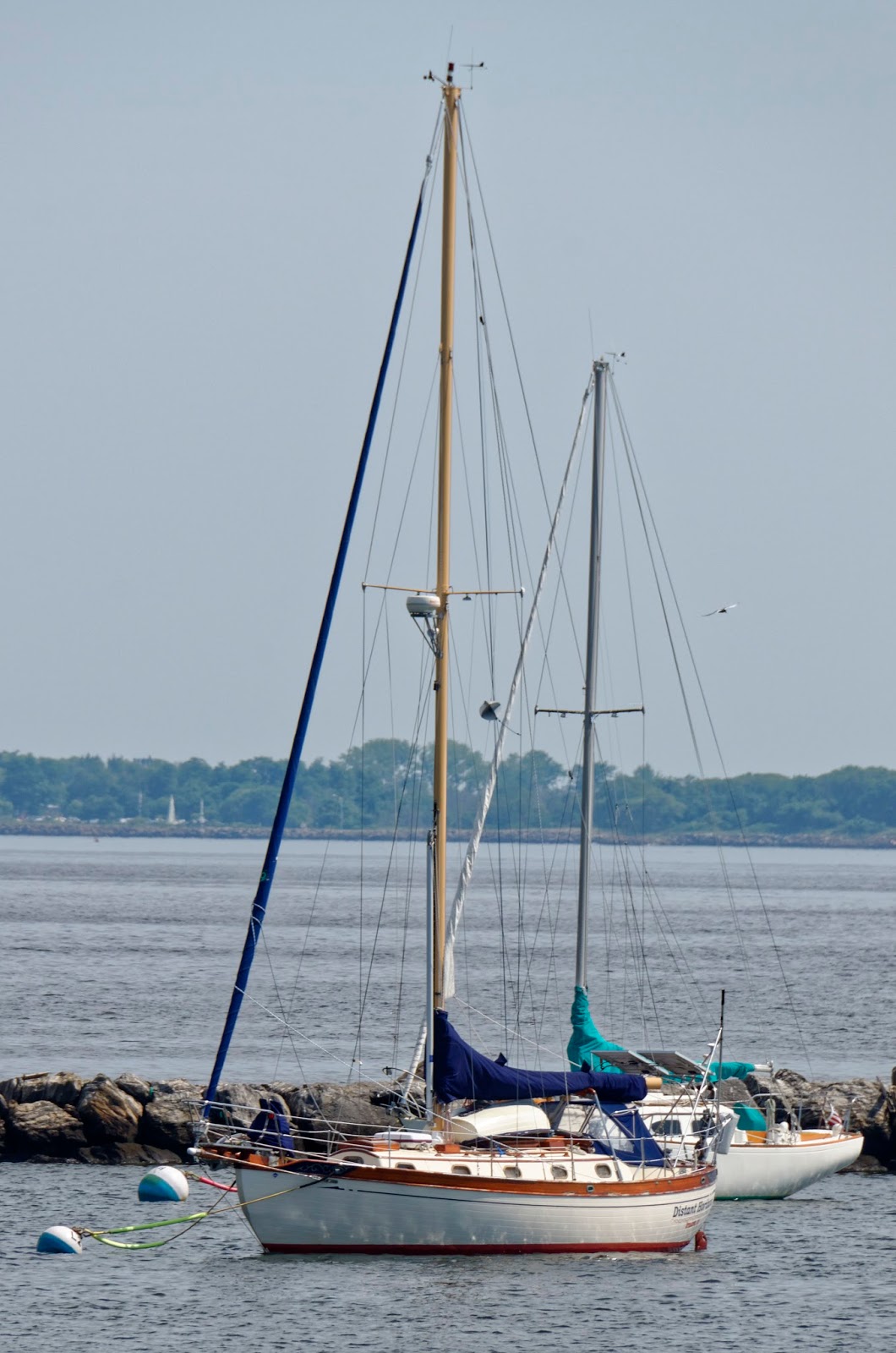
Distant Horizon on a mooring in Atlantic Highlands

I found out the next day from another launch captain, Bob... coincidentally, Rush's dad... Rush first thought I was on drugs: shaking hands; moving in slow motion and unsteady; pupils dilated; then acting like an energizer bunny... until he figured out it was sleep deprivation. That's why he just wanted to get me tucked away for a bit. Rush is also a State Trooper!

The next morning, I took care of a few of the smaller tasks since the launch wasn't available for a few hours. Then, I went to town to get oriented... Find the hardware store and have some breakfast. By lunch time, I was surprised how much I had accomplished. Good thing too. I was asleep by 4pm and didn't wake for another 4 hours. Then, I just made dinner and went back to sleep.

With all the smaller tasks completed, I started to drain the bad water tank; open the water tank and clean it out. It had a lot of sediment in the bottom of the tank. The water was still very brown after sitting still for a couple of days to settle. Even so, a large amount of suspended sediment was still there in the water itself. Once the tank was drained, I sponged out the remaining water and wiped up the sediment from the bottom of the tank to allow the tank to air-dry before vacuuming up any remaining sediment. The sponge, which was new, came out filthy with  dark black splotches of charcoal. From this, I surmised that the filter used when filling the tank had broken; allowing all the trapped sediment and bits of the filter into the tank. It probably just sat at the bottom of the tank until the heavy rolling stirred it up.

Once the tank was perfectly clean, I replaced the filter.

On Thursday, the harbour area started getting real busy. I called the launch. I was going to walk to West Marine to get some parts. I just needed directions. Bob gave me great directions while showing me a map. I asked, "wouldn't it be shorter to walk this way? He had a surprised look and asked if I was planning to walk there. I said yes. He reached in his pocket and  said "take my car," as he handed me the keys. "Go the way I showed you. The other way is shorter, only if you don't get lost".

I picked up the parts I needed, along with some spare parts. I also renewed my Tow Boat US membership; just in case the transmission failed completely. I figured that was cheap insurance compared to just a single tow.

On the ride back to the harbour, I stopped at the grocery store to replenish some of my fresh fruits and vegetables. That's when I realized how far the west marine was from the harbour area. It would have been a good 4-5 mile walk... each way.

That night, people started to gather at their boats. Soon after sunset, I realized this was Atlantic Highlands' July fourth celebration day... and I had a front row seat!

Atlantic Highlands July 4th celebration

With the boat ready, I just needed a good weather window to get me south. I was going to Annapolis to have the transmission taken care of. I wanted to sail the maximum distance to alleviate any strain on the transmission.

I spent most of Friday morning going over the weather data. I could do this because of the powered WiFi antenna I had installed on Distant Horizon. One constant at Atlantic Highlands is: everyone will complain about the weak Wifi signal that is only reliable if you sit next to the marina office. I tuned my antenna and had a good signal: 0.41 miles from the office!

It looked like Monday would be the perfect day. So, I settled in and prepared to stay a couple more days. There was no wind forecasted until then. I did a little sightseeing, although there really isn't much to see... at least on foot.

Saturday was quite warm, sunny, and muggy. There was no air movement anywhere.

On Sunday, we started with a little fog that cleared around 9am. A slight breeze crossed the back of my neck as I ate breakfast in the cockpit. A ripple showed up, traveling slowly between the moored boats.

This was it... I knew it! We would have wind today. If nothing else, there may be a sea breeze along the shore. I quickly prepared the boat for departure. When she was ready, I motored to the yacht club dock and filled the water tank. I was leaving a day early; knowing that I may drift through the night with no wind, but happy knowing the forecasted winds would soon follow.

I was the fourth sailboat to exit the harbour.


Tuesday, July 4, 2017

Shakedown Cruise


The mast was stepped in Catskill several days ago. However, Distant Horizon has not been sailed just yet. You see, the wind typically blows up the river due to the high banks and cliffs that line much of the Hudson River's banks. Sailboats can not sail directly into the wind.

So, today we (Distant Horizon and I) are departing Liberty Landing Marina for the ocean. We are going for a shakedown cruise. A shakedown cruise is when you sail the boat with a deliberate attempt to discover what is right with the boat, and what is not. It is also used to make necessary adjustments to fine-tune the rigging and sails. According to NOAA Weather Radio, the conditions should be perfect!

The plan was to go for two days. I would sail on the outbound course as if I was starting the transatlantic. If the shakedown went well, I could simply continue.

With the engine running and warming up, I slipped the lines at the dock, like I have hundreds of times before. I stepped aboard Distant Horizon and shifted into forward gear. ... nothing... We were moving away from the dock, but that was just the outgoing tide gently pulling us along. I shifted to neutral and back into forward... still nothing! We were getting farther from the dock. I grabbed the stern line and jumped for it. I landed firmly on the dock and secured the line after pulling the boat closer. Then, I secured the other dock lines and turned the engine off.

This is not how I wanted to start the day!

This had happened twice before: once in the canal; and another time in Waterford. Each time, the transmission was very low on fluid. So, I knew the drill. Empty the cockpit locker; remove the floor from the locker and climb down into the engine compartment. Once again, I found the transmission to be very low on fluid. I had bought more in Waterford, but I had just a few quarts left. I added about a quart and a half. I started the engine and tested the transmission before putting everything back together. It worked perfectly.

With the locker back together and everything stowed where it should be and the engine running, I slipped the dock lines just as before. This time when I shifted to forward gear, the boat started to go! Finally, we were underway.

Statue of Liberty
After passing the Statue of Liberty, I had to wind my way through the New York Harbour. It was like running a slalom. Instead of gates or pylons, I was going around large tugs and barges at anchor. Once through that section, there are the ocean going ships that are coming and going.

Ocean going ships entering New York Harbour
 If you look on a map, New York Harbour covers a large geographical area. However, it is fairly shallow with several shoals and rocks. There are traffic lanes to keep the ships in order and help to avoid collisions. I was following the channel for the proper outgoing traffic lane. Not being a big ship, I follow on the edge and usually slightly outside the channel. All ships I encounter will be following the lanes. So, I know they will be coming from behind me and passing. There is no concern of ships coming at me or from either side.

While still in the harbour area, the wind started to fill. I took time to put all sails up now,  before reaching the ocean.

There was 14 knots of wind. The motor was off for the first time this season. Now, I was sailing! When I actually reached the Atlantic Ocean, I turned East-South-East (ESE). I adjusted the sails and double checked that they were all adjusted as they should be. They weren't, but it was just a few minor changes to get the lines pulling at the proper angles. There was a reef in the mainsail as night was approaching. Still, Distant Horizon was doing 6.8 to 7.2 knots, which is a great speed. Now I was really sailing!

Post-sunset glow
I always carry an extra reef at night. A reef is when you let a portion of the sail down to make the sail small. Since it is smaller, the sail generates less power. It's like easing your foot off the gas as you enter a turn.  At night, you can't see a storm, or squall coming and could quickly become overpowered. So, to spare myself the drama and excitement, I put a reef in before sunset.

All afternoon, the winds were gradually decreasing, but we were still sailing. Shortly after sunset, the wind dropped to nothing. My wind instrument read 0.0 knots, which is very rare. Even if I was drifting with a current it would read 0.2 or some other appropriately low number.

With no wind, the sails start flapping side-to-side as the boat rolls with the waves and swells. This constant flapping can really wear on a sail. The rolling wasn't too bad. So, I dropped all the sails. Without the sails, the rolling became predictable worst. I was not going anywhere. So, I turned a deck light on; set the radar and AIS alarms; and went below for a nap.

I don't typically sleep at night when at sea. I feel safer if I stand a night watch. During the day, the large ocean vessels maintain a full crew. With the sails up, it is much easier for them to spot the boat. I set the alarm clock to wake me in two hours.

I took a snack and a drink up to the cockpit with me to start the first long night watch. There was a slight breeze. The cool sea air felt refreshing and did its part at waking me up. The moon was just setting. It would be a dark night.

The wind started to increase again and Distant Horizon was sailing well. I could see lights on the horizon. Lots of lights spread across most of the horizon. It was a lot of fishing boats. I was approaching the Hudson Canyon. This was not going to be an easy, relaxing night.

As expected, I spent the majority of the night dodging fishing boats. I was moving between 4-6 knots. They were moving between 4-20 knots. Some of the captains were very helpful; telling me to stay on course, we would pass within a half mile of each other, but I would pass a half mile behind them. Others were grumpy old codgers.

One boat in particular did not communicate. It was coming from the south at 20 knots. We were on a collision course. I kept hailing them, but never got a response. I finally just turned and dumped all the wind out my sails and let them pass by. My best guess is the person on watch turned the volume on the radio down and fell asleep.

As dawn approached, I was well past the fishing fleet. The winds were light. The sky was hazy making the sunrise unremarkable.

We progressed with very light winds. I fought to keep the boat sailing; searching for the the right wind and sail combination that would allow me to go below and get some rest. This was good. It gave me plenty of opportunities to try sail combinations, I would not normally use. Distant Horizon was moving between 3-4 knots in very light conditions. I was happy, but busier than I wanted to be. Honestly, I wanted to be asleep.

Late-afternoon the wind had picked up slightly. Distant Horizon had her typical sails (mainsail, jib, and staysail) up and she was doing over 4 knots again. Time to get some rest!

I was woken suddenly as the boat rolled violently. I was nearly tossed out of my berth! I thought a big ship had gone past us, but none of the alarms went off.

The rolling did not stop. It was so bad that as I climbed the companionway steps to the cockpit, I had to go one step at a time. After each step, securing my hands and wait for that brief moment when everything stops, before the rolling motion reverses its direction. Then, I would take the next step.

I had a safety tether to put on before going out into the cockpit. Even with the tether, I could not stand. So, I crawled out to the cockpit. Then, I sat and slid myself around to the helm.

Thankfully, the sun was still up. I could see the huge swell coming from the south. I wasn't at the time, and still not sure why it suddenly started, but this swell was big enough to block out the horizon as I sat in the cockpit.

I tried putting the mainsail up. That decreased the rolling by a significant amount, but the mainsail was really taking a beating as it violently snapped from one side to other, synchronously with the rolling motion.

I remember when talking with Pete, the circumnavigator I met in Waterford, that he used his storm jib. So, I dropped the mainsail; went below to get the storm jib; went forward to the bow to hank on that sail. It did help reduce the rolling quite a bit, but there was still a lot of rolling going on. The storm jib is so small, that when it is sheeted tight, it barely flaps at all.

The rolling continued into the night. The wind started to pick up. At six knots of wind, I was able to get Distant Horizon sailing. At first, she would start to move, but the rolling would knock the wind out of the sails. Each time this happened, the she would retain a little speed gained. Gradually building enough power to overcome the rolling.  It was a slow process of building enough speed to keep the wind in the sails.

 Once we were sailing again, the rolling didn't seem that bad. I went back below to get a short nap, since there were no other boats around. I got a glass of water to keep hydrated. It was brown! Dark Brown! I had cleaned the tanks last fall, and again before we departed Baldwinsville. I had no idea what would cause this. So, I switched over to the other tank. I ran the faucet for a minute and it cleared up. To be safe, I ran it a little longer before giving it a taste. It seemed okay.

I had barely started the trip, if I was to continue, and I was already down to 50% of my water supply. A quick calculation showed that was enough water to get me to Ireland in 4 weeks. However, I was traveling 40-50 miles a day. Distant Horizon should be doing 120-130 miles a day. I had no idea how long these light winds would last. I didn't know if there was something in the water that would eventually turn the currently good tank, bad.

It was around 10pm. The winds died to nothing again. I was forced once more to take all the sails down. I decided, the shakedown was over. Everything was not just right to continue across the Atlantic. So, it was time to turn around. I had a full fuel tank, but was that enough to get me back? I decided it was, if the winds would come back from time-to-time as they have been. I switched the engine on and held my breath, as I put the transmission in forward gear. We were moving!

4th of July sunrise
Unlike the previous morning, the pre-dawn light painted the sky in very typical pastels that would change like a kaleidoscope as the sun approached the horizon.

It took 30 hours to motor back. The winds never did return. Motoring in no wind conditions, means no sleep. I had to hand-steer all the way back.

I brought the boat to Atlantic Highlands and got a mooring. Tomorrow, I will start the necessary repairs. For now, it was time to get some solid sleep.


Friday, June 30, 2017

Hudson River to New York Harbour

I awoke early to catch the ebbing tide (outgoing). I was sad to be alone. Grace was great company. However, I was finally getting excited. My adventure was really starting! 

The Hudson River is not good for sailing except under rare circumstances. For the most part, the western shore is high above the river. This tends to funnel winds along the river. Here, this guy is sailing on the Hudson. Notice, he is going across the river. When he tacked to change direction, he went back across the river again.

Sailing on the Hudson River
For Distant Horizon, this meant her diesel engine would be running most of the way. The biggest difference with the mast being up, is boat wakes. With the mast down, the boat was very unstable and we had to carefully negotiate wakes. Now, Distant Horizon is well balanced and she just drives through the wakes.

The tide turns roughly every 6 hours. Going with the tide meant traveling a little more than one knot faster than we would with no current, and almost three knots faster than against the current. When the tide turned against us, I was nearby Kingston, NY. It’s a great little town with a nice town dock and restaurants and shops nearby. The village is up a creek about 2 miles. The inlet is lined by a stone wall on either side. 

Kingston Lighthouse
However, I just wanted to make a short stop; get some rest ; and get moving again. So, instead of turning, I passed the inlet. Just south of the wall is a nice calm bay. There is shallow water there. I continued a little farther south where the water is deeper. Then I turned in and headed north a little to drop the anchor.

It was a perfect anchorage. The shallows actually protected me from the wakes of big tugs and barges heading south. There was no protection form the wakes of boat, tugs, or barges heading north. I know because one, just one, went by. After getting the boat set, I began to make some pasta salad for lunch. I figured that was good protein and carbs for my trip. 

When lunch was done, and dishes…. I was about to settle in when I heard the distant rumble of the all too familiar thunderstorm. Ten minutes later, it was pouring! No hail, but the NOAA weather radio was warning of the potential for quarter-size hail with this storm. I knew I was secure… and for a change would stay dry during this storm. So, I settled in my berth for a nap. Other than being awaken once, from a huge clap of thunder which seemed to be directly overhead, I slept for three hours. The tides would switch soon, so it was time to get ready to depart.

The sky was clear again. Based on the tide schedule, I would be going until 3am. Everything was running smoothly: engine was running low RPMs; engine temp was perfect; oil pressure was good; speed was fantastic! 

You have to expect brief encounters with commercial tugboat traffic when you travel on the Hudson River. There is a constant flow between New York Harbour and Albany. This is the same tug that verified my AIS was working. Just one day ago, he was traveling north. Now, he is on his return trip.

Tugboat Kimberly Poling pushing a barge south on the Hudson River
After dark, navigation becomes somewhat simpler. It's easier to pick out the channel markers from their lights. The difficulty is trying to determine the next one, when there are more than one and none of them are close by.  Also, navigation become difficult when there are too many lights to discern the lights of another vessel. 

That is exactly what happened around 11:00pm. From a distance, it looked like a village at the far end of a long straight section of the river. As I slowly drew closer, the scale change at a disproportionate rate. I knew it was a ship or barge of some kind. I zoomed out on the chart plotter and saw their AIS marker. It was a cargo ship, SBI Cronos. It was not moving. I assumed they had anchored and half an hour later when I passed them I was able to confirm that they had stopped and anchored in the middle of the channel. They had all their deck lights on. Yes, I did not see a single person on deck. They may think this makes them highly visible, but it would actually be much simpler if they used the proper lights to indicate they were anchored.

Negotiating the river and its current past West Point on a dark, moonless night was a challenge. The river narrows considerably. The river gets very deep and has several bends, creating currents that love to play with the six-foot full keel hanging from the bottom of Distant Horizon.

After passing West Point, there were still a few more bends in the river before reaching my planned anchorage, which would be another short stop to rest and wait for the tide to change. 

Typically, you look for three factors in an anchorage: #1 A bottom with good holding for your anchor with enough water below the boat; #2 Protection from waves and wakes; #3 Protection from wind. Since I am making short stops, I picked my spots based on #1 and tried to find #2 knowing #3 was not available. Actually #2 is rare and usually hidden behind an island on the Hudson River and those take  time to negotiate. I was looking for spots just out of the channel where I would be safe from tugs and their barges and far enough off to be away from power boaters who don’t need to follow the channel because of their shadow draft. 

I chose a great spot, for my purposes, across from the Indian Point Nuclear Power Plant. I still had to round Jones Point, a very sharp and narrow bend in the river. Just before Jones Point, there is a green channel marker. It sits atop a rock sticking above the water. So, the channel is much narrower than the river. As I passed under the Bear Mountain Bridge and saw the marker, I knew I was getting close. Good thing too. I was starting to fight off head-bobs!

It was 3:15am. As if on queue to rescue my fading consciousness, I hear something on the VHF radio. The sound startled me after hours of silence. To me, the sound was more like noise. Although, clear sounding, I was so tired I found it difficult to pick out some discernible words; but what did stand out was “Distant Horizon”. I quickly grabbed the mic and replied, “This is Distant Horizon, go ahead”. 

It was the Captain of tugboat Timothy L Reinauer! He said he was around Jones Point and our CPA (Closest Point of Approach) was too close for his comfort level. He asked what kind of boat and how big was Distant Horizon. I gave him the information. He replied stating that he would slow until we pass safely port-to-port; He needed to stay in the center of the channel around Indian Point. 

That seemed reasonable, but I didn’t want to slow him down and I saw on the charts, the deep water extended almost to shore. So, I replied that I would keep starboard as close to the western shore as safely possible and go out side green marker "27" where I would have plenty of water. He was very appreciative and said if I went outside the marker, he could continue as normal.  As I rounded Jones Point, I saw the typical Hudson River Tug pushing a barge. I don’t know if it was the darkness or the steep banks along the river, or my tired state, but it was a much closer view than I am accustomed to. It felt like I could touch that barge with a boat hook. The chart plotter said we were 200 feet apart; still very close.

I was around the point in deepish water headed for the spot I planned to anchor. I turned around and watched him negotiate the sharp bend. I immediately understood why he had hailed me on the radio. Add that to my long list of “Man, am I glad I installed an AIS transponder” list! With out the AIS transponder, he would not have know I was even there! Due to the bend of the river and steepness of the banks, radar would not have shown me! I would have been in the shadow of the hills! Now I know why the big ship captains always say, “Thank you for making the waters safer” when I ask if they are receiving my AIS signal.

Anchoring in the dark is a more challenging adventure since your depth perception is degragated. I got the job done quickly; went below and immediately crashed in my berth. When I was woken by the alarm, it was light outside. I was in 12 feet of water; perfect! The first thing I noticed was the sound of a train passing by. I never heard a thing all night!

I prepared breakfast. It’s easier to eat peacefully in the cockpit at anchor, than trying to steer the boat safely while running up and down to the galley! After breakfast, I got moving again. My plan was to stop in Yonkers. Each time I travel the Hudson River, I notice the sign: "Free Transient Docks Open”. Since Yonkers is just 90 minutes north of New York, it is never appropriate to check it out. So, one of the goals for this trip was to stop in Yonkers and check out their transient docks. I was excited for this small tangental stop as I approached. I have never been there. 

To say it was anticlimactic would be a gross understatement. A tug had gone by shortly before I reached the docks. I could see the huge wake batter the dock without mercy. The dock showed the wear from boats that were unaware. The rubber cushions were torn or missing. The wood, which should be underneath the cushions was badly split and splintering. I knew instantly, I did not want the outside… but what about the inside? 

The wind was blowing straight up the river. If I pulled Distant Horizon into the dock, I would not be able to get out; for two reasons; Distant Horizon does not go astern (backup) well with power, and the water got very shallow closer to shore. So, I lined up with the dock and drifted in stern to; meaning I was preparing to drift into the dock backwards. This way I could measure the rate of drift if I decided to dock there so I could back in the rest of the way. This would allow me to pull straight out when it was time to leave. 

As the inner side of the dock became visible, I saw it was line with tires. That is beyond horrible!  I failed myself. I was so determined to see Yonkers. I did not have another plan. All I knew at this moment was, I could not stop here!

As I headed further south, I continually checked for available anchorages or stopping point of some kind. On the charts, the north side of the George Washington Bridge, on the east side of the river looked like a possible spot. As I approached, I left the channel to investigate. The current was crazy there! Although the charts said the water was 17 feet, it was closer to 30 feet. This was not a suitable anchorage. 

Looking back at the George Washington Bridge
The next spot was along the parkway. The charts listed this as 10-14 feet of water close to shore. Once again, it was 29-32 feet. I can anchor in that depth, but the length of chain required to do so safely would put me precariously close to shore; not to mention the Hudson River has strong currents in this area. There was absolutely no place to anchor. 

So, 79th Street Basin was next on my list. I always thought that place was cool! 79th street in Manhattan and you can stay on a mooring! Three blocks off the river, you catch the "Red Line" and you are in The City. 

Manhattan Skyline from the Hudson River
I hailed them 5 times on the radio… no response. Finally, I had to stop at the only other place I knew, an upper scale marina in Jersey City: Liberty Landing. I knew I could top-off my fuel there before heading out to the ocean.  I hailed them on the radio and got an immediate response. 

When I arrived, I had to negotiate the “Jetski Skyline Tour”. Their group was behind me, but completely unaware of the rules. In no time, my 28,000 pound boat with limited steering at slow speeds was surrounded by jet skis with two and three people on them. It is required that they negotiate an agreement with me before passing. In this case, I figured out who the tour guide was and informed her of my intentions and I was unable to stop and wait, or maneuver through her group. You could see the awareness flood her face and she quickly gathered them up and got them past me so I could make my turn to the fuel dock. After getting fuel, I was given a slip assignment that would work with Distant Horizon.


Once docked, I immediately went to the captain’s lounge… well, I actually put my laundry in the washer and went to the Captain’s lounge to charge my computer and respond to people who had messaged me and check the weather. When those tasks were completed, I quickly got to sleep. It would be another early morning. First to catch the ebbing tide. Secondly, to beat the tugs to the river; a key element around Manhattan. There is no beating the ferries. The nice thing about them is, there are no negotiations... stay out of their way! 

Tuesday, June 27, 2017

One lock to go!

Grace and I were happy about our progress. We had successfully negotiated 30 locks over the past two weeks. During that time we sat at the top of Lock #24 in our home village of Baldwinsville; making provisioning an relatively easy task.

Now, from Waterford, there is just one lock to go before reaching the tidal portion of the Hudson River. That is the Troy Federal Lock in Troy, NY.  This lock is run by the US Army Corps of Engineers.

Before departing, we made one trip to Ron and Paul's for breakfast. After all those days of early starts, I owed Grace a breakfast and a relaxed start. We knew from experience the trip to Catskill would not take the whole day. We departed about 10:15.

The Troy Federal Lock is just about two miles from Waterford. So, it doesn't take long. I hailed them on the radio: "Troy Lock...", but no response. The chart lists the lock as Troy Lock. I tried, US Lock #1, Lock #1... Altogether, I tried five times before getting a response. That was, "You are trying to hail the Troy Federal Lock". That was it, no other communication. So, I continued to say over the radio, "We are traveling south and request transit through the lock". The operator, responded in a very belligerent tone... "You request a transit south through the Troy Federal Lock." I simply said, "Yes, sir". At this point I was not going to use his terminology. I did use the nomenclature on the chart.

He eventually opened the door. It close quickly behind us. As I pull into a lock, with the mast hanging out ahead of the boat, the mast will swing over the lock wall. Before we could secure a line, the lock was dropping. My mast was over the wall. We were free-floating in the lock and the currents were reecking havoc with Distant Horizon's keel. I'm shouting "Stop! ... Stop!" We start dropping faster. My mast is beginning to bend as it is holding the weight of the 28,000 pound boat up on the wall. I start shouting, "Up! Up!" Finally we stop.

The operator slowly walks down the lock to our location. As he reaches us, I get the mast off the wall and we drop about three feet. His first response was, "I can't stop xxx gallons instantly". Did I hear that right? Hi first response was an excuse? He didn't inquire if as to the cause of the all the shouting and why he had to stop the lock? He screwed up and knew it!

I tried to explain what had happened... and all he wanted to do was change the subject and asked for  my Documentation Number! I knew 12 year-old hockey players who were more mature. He was definitely acting like he was a twelve year old in trouble! There was no getting any forms from him to file the incident!

Well, our 31st lock, reverse the numbers and it was unlucky 13! At least both Grace and I were okay. This could have been much worst with Grace leaning over the the side of the boat trying to get a line on the pipe; the mast falling on us... I didn't want to think of everything else that could have gone wrong.

We got out of there quickly. As we were leaving the lock, I hear the operator say, "Have a safe day!"

Now the cradle that holds out mast up is partially split and we would have to deal with big boats and their wakes on the Hudson River!

With the tide running with us, it seemed like we flew through Troy and Albany.

Before leaving Baldwinsville, my good friend Don asked if we would pass under the Thruway bridge that crosses the Hudson River as you turn east towards Mass. Then, he told me what it was like on his motorcycle trying to cross the bridge and still look over the side. So, Don. Here's a different perspective. I took this from Castleton-On-Hudson. For scale, under the left side of the bridge is an ocean going barge. It was docked and being unloaded. So, I couldn't get it passing under.

Castleton-On-Hudson Bridge
Just north of the bridge is Castleton Boat Club. Here, you can rent their Gin Pole and step your own mast. My mast is too heavy for Grace and me to manage. That is why we are going to Catskill where they have a crane to do the heavy work. The Gin Pole is on the right side of this photo, just above the sailboat.

Castleton Boat Club
A thunderstorm was approaching shortly after passing under the bridge. I sent Grace below because of the lightning. I had to steer, which was ok. The boat has a wood wheel, and the solar panels are over my head. The safest place in a thunderstorm is a car... not because of the rubber tires, but because of the metal roof overhead. If struck by lightning, the air would ionize, preventing the lightning from  going beneath the metal roof! I was hoping the same was true for the solar panels, but I would be happier no to test my theory.

I got soaked from the downpour associated with the storm. About 20 minutes after that ended, we were hit by another. I had a foul weather jacket on, but not the pants. I was regretting that. The rain was cold.

An hour later, another thunderstorm hit us. I put on the leather gloves we use in the locks; hoping the leather would help keep my hands warm. This thunderstorm came with all accouterments... meaning enough pea-sized hail to collect in the cockpit. I was standing in ice water from the hail!

Pea-size hail
A half hour later, another thunderstorm! I changed my tactics. Grace had taken the wheel so I could change into dry clothes. Now, I was just going to circle back north close and let the thunderstorms pass ahead of us. This fourth thunderstorm was the biggest of all. The boat was heeling over from the wind. So, I pulled close to the western shore where there was barely a ripple. Here we could hide from the winds while we waited.

There were five thunderstorms in all as we traveled south on the Hudson River. When it was all over, we were blessed with this full rainbow! A second started, but then faded away.

Full Rainbow!

This typical Hudson River Lighthouse sits in the middle of the river, marking the side of the channel. It is just a couple miles before the Rip Van Winkle Bridge, which connects Catskill to the other side of the river. We are almost there, and this day of drama is just about over!

Hudson River Lighthouse